

The Flourishing Context Map: a discovery canvas for human flourishing
Earlier this year, a partner organization in Quebec asked me a question I could not stop thinking about. We are preparing a bootcamp where members of its professional community will identify, develop and pitch new ventures, and they wanted to centre the entire process on human flourishing. Not consumer wants. Not pain points. Flourishing: whether the people a venture serves end up living well.
I said yes before I fully knew what I was saying yes to. I was only made aware of Harvard’s flourishing framework when they pitched the idea. So I had to learn it properly for this project, and learning it deepened my conviction that the brief was right. Then I went looking for the discovery tool that would carry it, and I did not find one.
The gap
Design thinking anchors its problem space in desire and friction. Empathy maps ask what people think, feel, say and do. Jobs to be done asks what progress people are trying to make. Value proposition thinking asks about pains and gains. These are good tools, and they share an assumption: that what people want is a reliable compass for what we should build. Sometimes it is. I argued in Beyond wants that often it is not, and that the science of human flourishing offers a better compass for ventures aimed at social value.
But an argument is not a tool. The closest thing I found is the Human Flourishing Design Guide by Henrique Ibaldo, a thoughtful translation of well-being science into design decisions for technologists. It lives in the solution space: it helps you evaluate what you are already building. I found nothing that anchored the problem space, the moment before any idea exists, in a flourishing framework. That was the gap. So I built the Flourishing Context Map.
The honest part
Three concessions before the tour:
- This canvas measures nothing. Harvard’s Human Flourishing Program has a validated measure for that, and this canvas deliberately does not include or administer it. It structures a conversation, not a dataset.
- The science underneath is strong on associations and careful about causes. The framework says which domains constitute flourishing and which pathways predict it. It does not hand anyone certainty about what an intervention will do.
- At the time of writing, the canvas has not survived a real room. It goes through its first workshops in the coming months. I am publishing before it is proven because open tools improve faster than private ones, and I would rather have it broken by strangers than polished in a drawer. I will report what breaks.
The framework, and the move that makes it designable
The canvas is built on Tyler VanderWeele’s flourishing framework, published in PNAS in 2017 and developed by the Human Flourishing Program at Harvard. It describes five domains that nearly everyone desires as ends in themselves: happiness and life satisfaction, mental and physical health, meaning and purpose, character and virtue, and close social relationships. VanderWeele adds financial and material stability, not as a sixth end but as the means that sustains the other five over time. And he identifies four major pathways through which flourishing is largely produced: family, work, education, and religious community.
The move that makes this designable is the distinction between ends and levers. No venture builds happiness directly. No product installs meaning. The domains are outcomes. What a venture can actually touch is the machinery that produces them: a work arrangement, a learning structure, a form of belonging. You cannot design a domain. You can design for a pathway. Once I saw that, the shape of the canvas followed.
The canvas
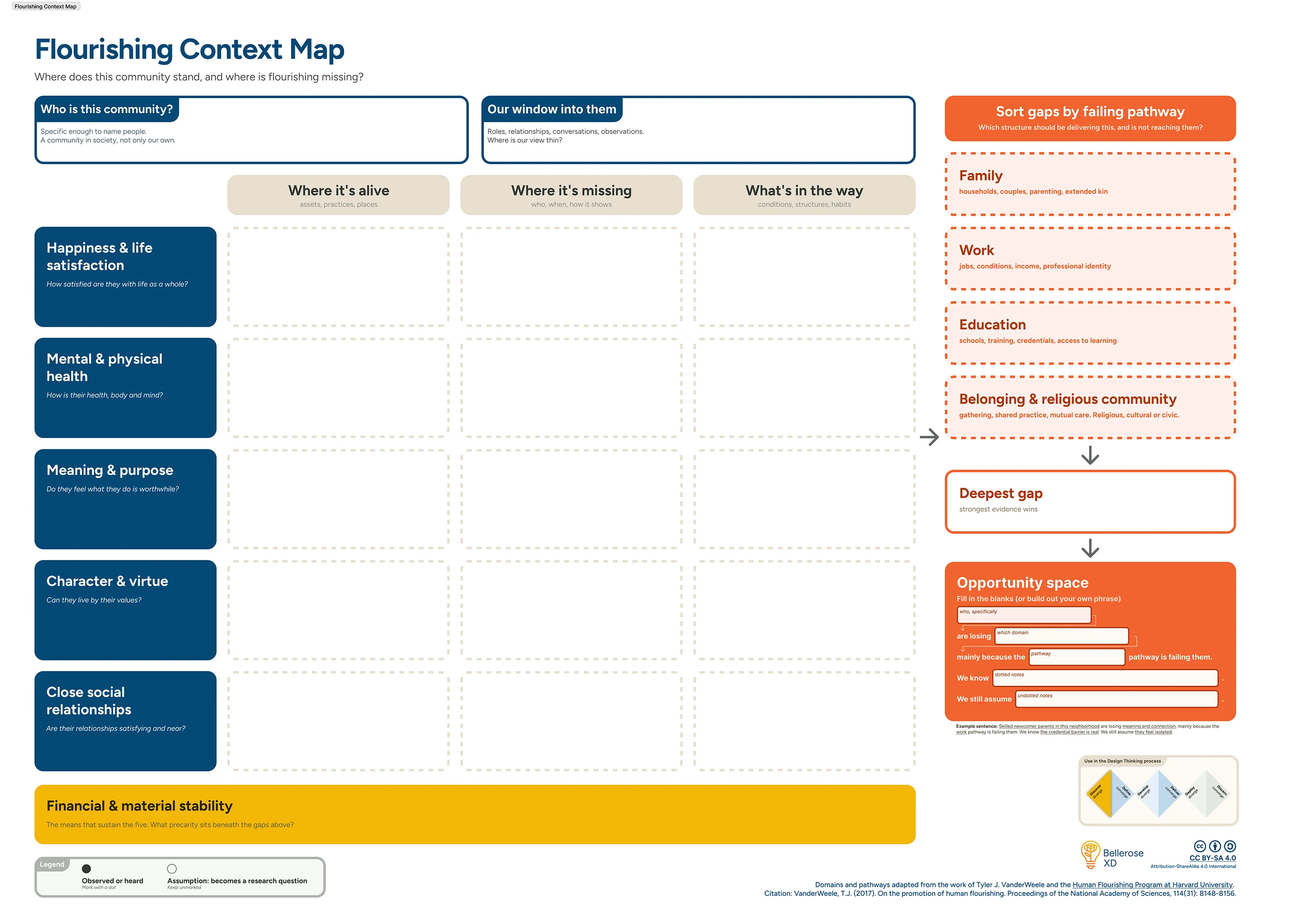
How it works

A team starts by defining a community precisely enough to name real people in it, and by stating honestly what their window into that community is: roles, relationships, conversations, observations, and where that view is thin. The mapped community is chosen in society at large, not drawn from the team’s own circle.
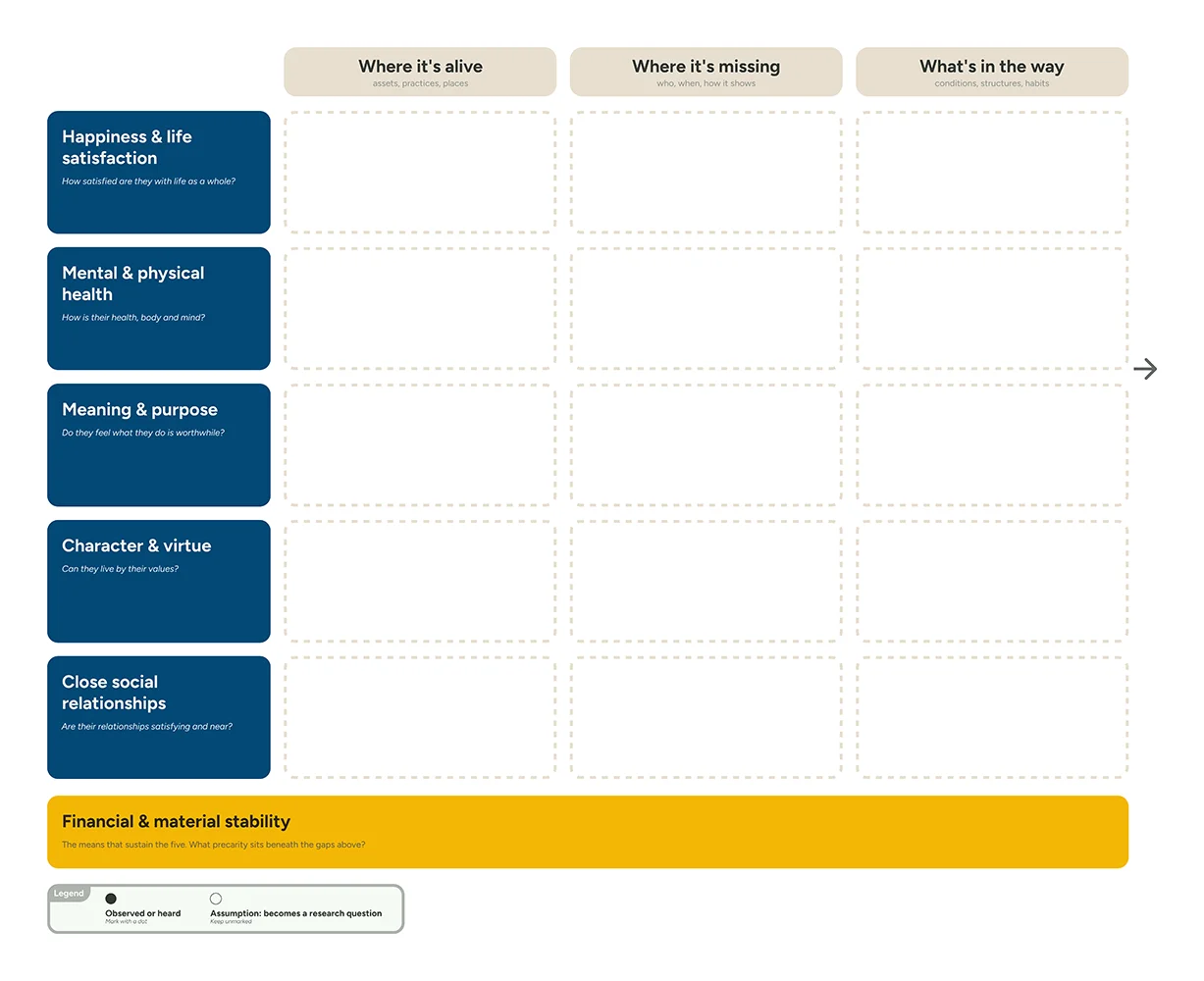
Then the grid. Each of the five domains is crossed with three questions. Where is this domain alive for these people? Where is it missing? What stands in the way? Every note is marked as it goes up: a dot if it comes from something observed or heard, no dot if it is an assumption. Undotted notes are not discarded. They become the team’s research questions. This rule exists because teams that care about a community will project onto it, and honest gaps in knowledge are more useful than confident guesses.
Below the grid, a foundation band asks one question: what financial or material precarity sits beneath the gaps above? When one material condition feeds gaps in two or three domains, the team has found a root. Roots change what kind of venture makes sense.
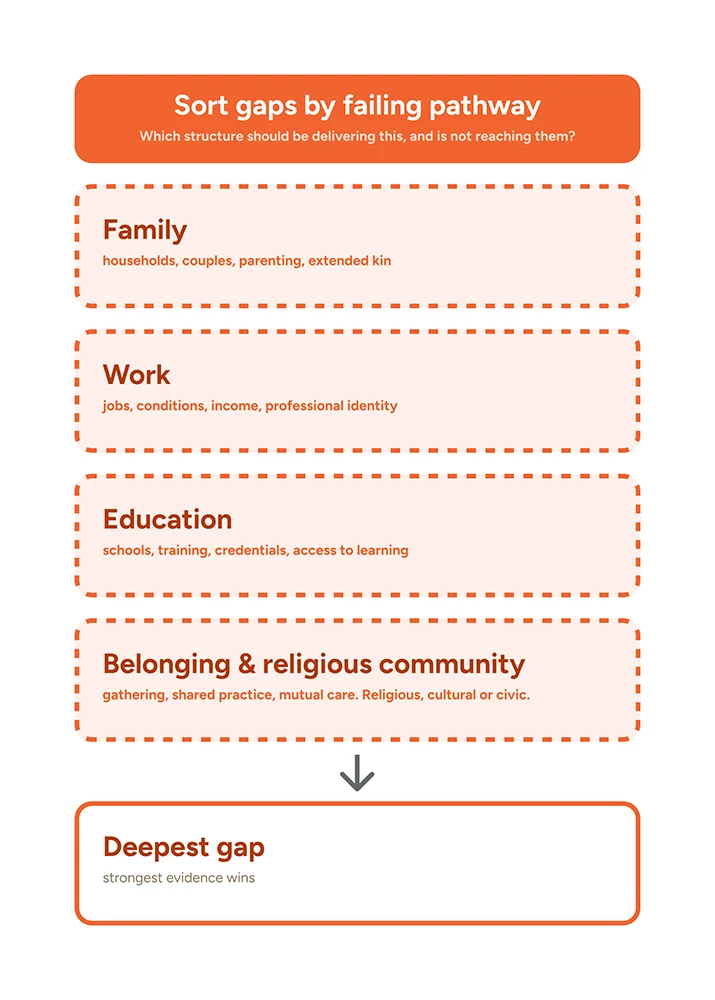
Then convergence. The team takes the notes from the missing and blocked columns and sorts them by failing pathway: which structure should be delivering this, and is not reaching these people? A crowded slot is a diagnosis. It names where the machinery is broken, and machinery is what a venture can fix.
One adaptation is worth naming. I broadened the fourth pathway to belonging and religious community, so teams can map cultural and civic structures of belonging alongside religious ones. VanderWeele notes himself that the four pathways are not intended to be exhaustive. The change is documented on the canvas as what it is: an adaptation.
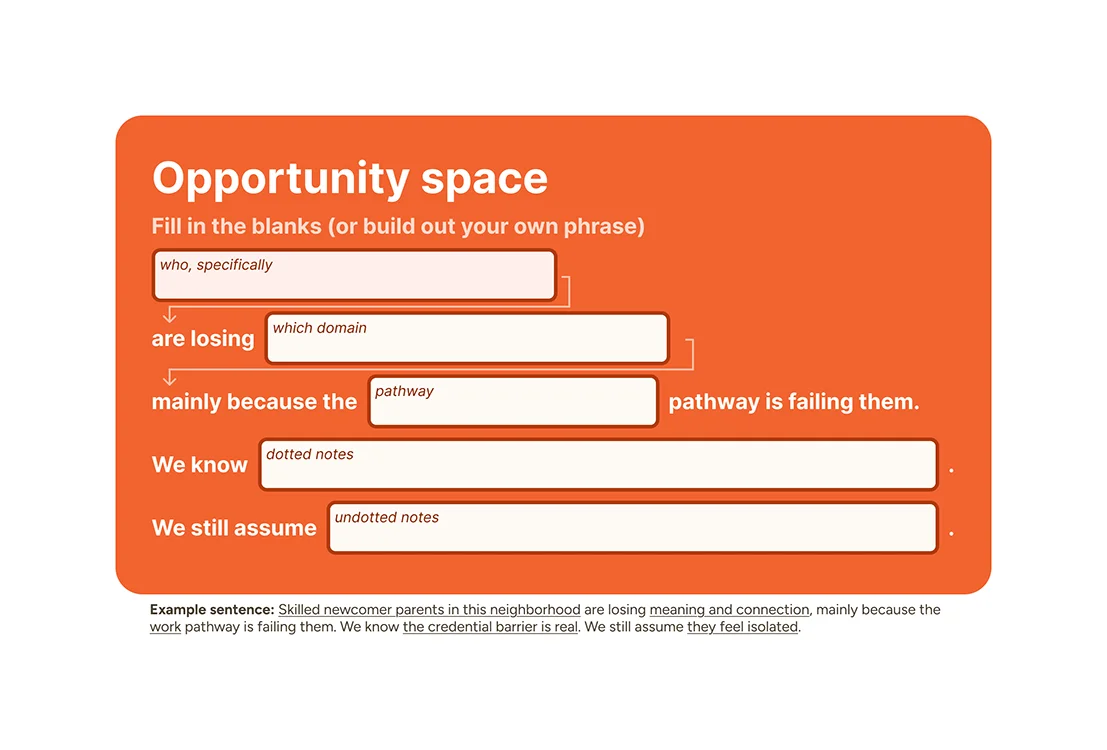
The canvas ends in a sentence, not a solution. [Community] are losing [domain], mainly because the [pathway] pathway is failing them. We know [this]. We still assume [that]. The split between evidence and assumption is written into the closing statement on purpose. It is the handoff into problem definition, and it tells the team whether their next step is ideation or more field conversations.
What comes after the map
The Context Map diagnoses; it does not decide. A second canvas, the Flourishing Opportunity Brief, will turn the diagnosis into a committed design challenge. A third piece, the Flourishing Impact Check, will ask the same three questions at every convergence point of the process: which domain does this move, through which pathway, and how would we know? Both are in progress, and both will be released the same way this one is.
Released open
The Flourishing Context Map is published under CC BY-SA 4.0. You can copy it on Figma, use it in your own practice, commercial work included, adapt it, and keep your adaptations open under the same license. The facilitation guide ships with it. The Business Model Canvas spread because it was open, and a tool like this one only gets better by meeting communities I will never meet. If you use it, tell me what breaks. That is the most valuable thing a reader of this piece can send me.
Domains and pathways adapted from the work of Tyler J. VanderWeele and the Human Flourishing Program at Harvard University. Citation: VanderWeele, T.J. (2017). On the promotion of human flourishing. Proceedings of the National Academy of Sciences, 114(31): 8148-8156. This canvas does not include or administer the Flourishing Measure; for the measure itself, see the Program’s terms at the page linked above.
About the author
Louis-Philippe Bellerose
Founder and Principal Consultant