
The Best Ideas Are Already in the Room
Most of my work comes down to a single belief: the answer to a problem is usually already in the room. The catch is that no single person is holding it.
It’s fragmented. One person understands a technical constraint. Another knows what users actually do. Someone in the corner has watched two earlier versions of this idea fail and knows exactly why. Each of these is something the team already knows. None of them is the whole picture. The solution exists, but it’s distributed in pieces across people who have never had the right occasion gather the pices of the puzzle.
That reframes what the work is. It isn’t extracting a hidden insight from one clever head. It’s reconciliation. It’s creating the moment where the fragments get put next to each other and the team realizes that, together, they already make sense.
This is where I want to be careful about artifacts, because I love them and they are easy to overrate. A journey map, a set of personas, a clear information architecture: these are genuinely useful. They organize what we know and give a team something concrete to point at. But an artifact, on its own, does not create engagement. You can hand a group a beautiful diagram and watch nothing change. The artifact is a tool for creating the conversation. It is not a substitute for it. The value was never in the document. It was in the alignment the document was supposed to provoke, and a document can’t provoke that by sitting on a wall.
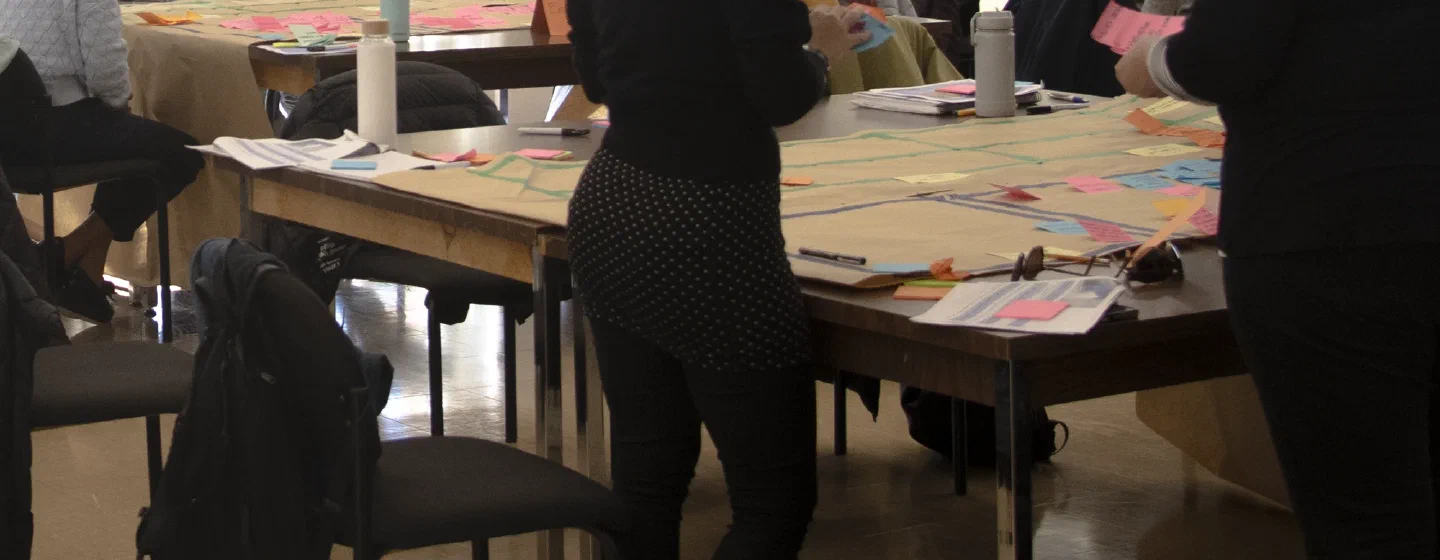
A workshop is the thing that does. Its real advantage is that it pulls stakeholders into meaningful conversation and actual decision making, in the same place, at the same time. That’s the setting where one person’s constraint meets another person’s user knowledge meets a third person’s hard-won experience, and the fragments start to fit. The artifact can absolutely serve that conversation, often it’s the best way to give people something to react to, but the engagement comes from the people, not the page.
Workshops can take many forms and I love full design thinking programs, but they aren’t necessarily adapted to every situation. Five phases, a week of sessions, a wall of sticky notes. Sometimes that’s the right tool. Often it isn’t. A lot of the time the real value comes from something much smaller: take the one knot the team keeps tripping over, put the right people around it for a focused couple of hours, and work it until it loosens. Or simply surface what should be the priorities for the next 4 years by asking employees and clients (as done with the Centre de services scolaire des Découvreurs). You don’t need the whole methodology. You need a clear question, the right people in the room, and enough structure that the loudest voice doesn’t crowd out the most useful one.
What a focused session does, beyond solving the immediate knot, is get everyone on the same train. People leave with a shared understanding of why a decision was made, not just what it was. That shared context is worth as much as the output itself, because it’s what keeps a team aligned through all the small decisions that come later, the ones no workshop will ever be in the room for.
Now the honest part, and it’s the part I care most about saying clearly. None of this works without genuine engagement from the decision makers. Not their attendance. Their engagement and their follow-through.
A workshop generates energy and reconciles ideas that people have, in many cases, been carrying in pieces for a long time. That’s a fragile thing. If the person with authority treats the session as a box to check, or lets the outcomes sit untouched afterward, the energy doesn’t just fade. It curdles. The ideas don’t translate into action on their own. The workshop also doesn’t appoint someone responsible for the next phase. If nothing is done, people learn that the conversation led nowhere, and the next time they keep their piece to themselves. You can end up worse off than if you had never run the session at all, because you’ve spent trust you can’t easily earn back.
So when I scope this kind of work, the first conversation I want isn’t about the agenda. It’s about what happens on the Monday after. Who owns the outcomes. What gets decided, by when, and how the people who contributed will see that their input went somewhere. If a client can’t answer that, the most useful thing I can do is say so before we book a room, not after.
The best idea is usually already in the room, scattered across the people in it. Reconciling it into something everyone can see is a craft. Making sure it survives contact with the calendar is leadership. You need both.
About the author
Louis-Philippe Bellerose
Founder and Principal Consultant